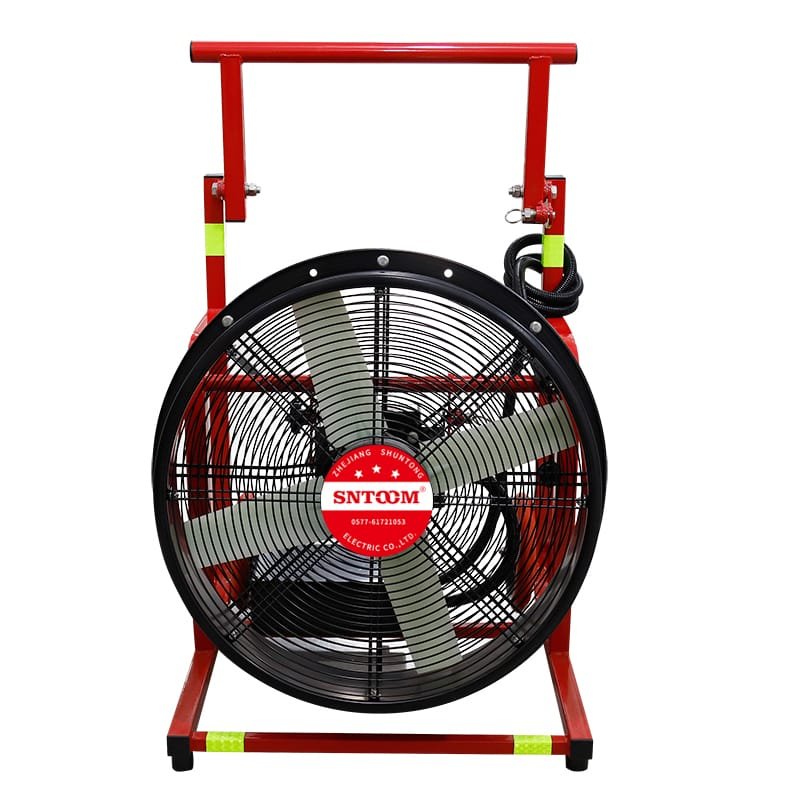
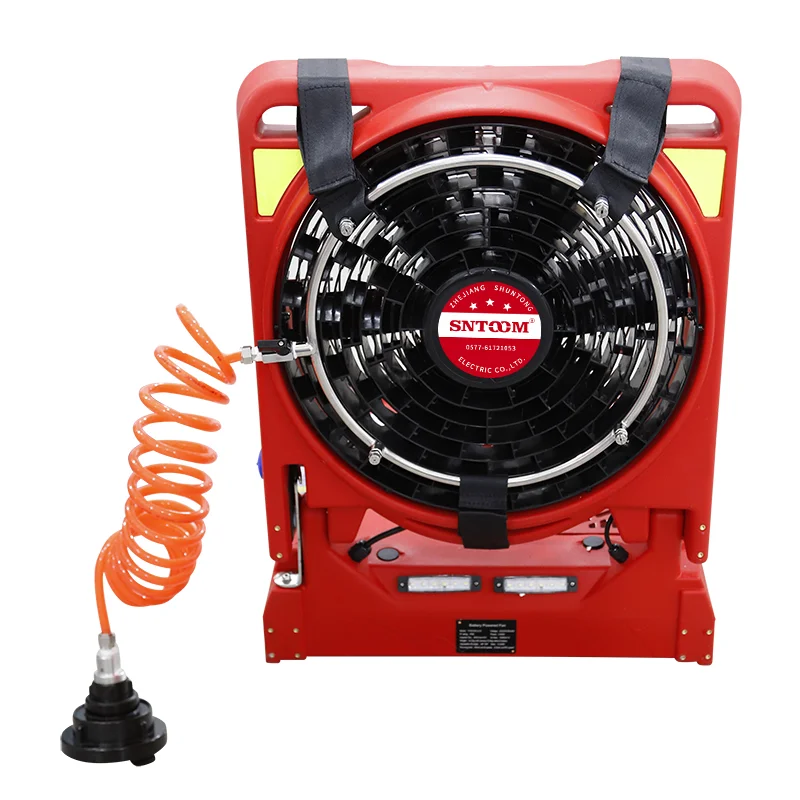
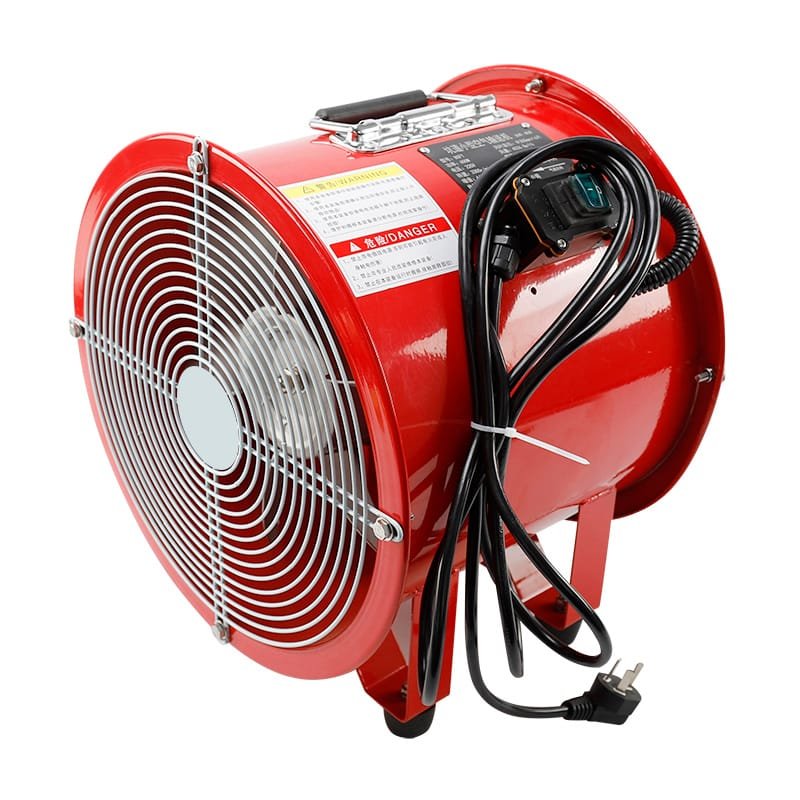
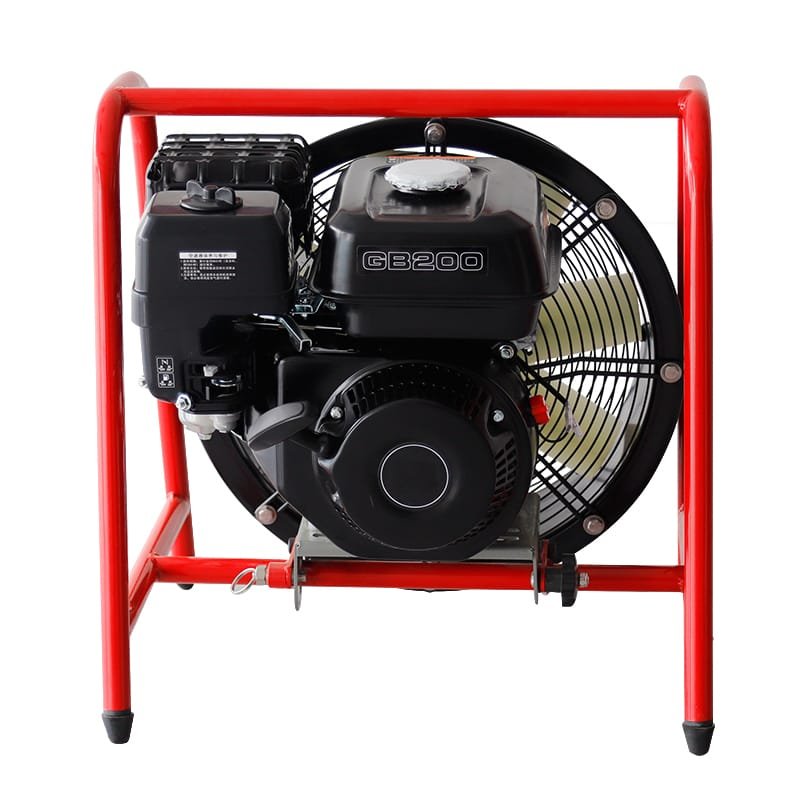
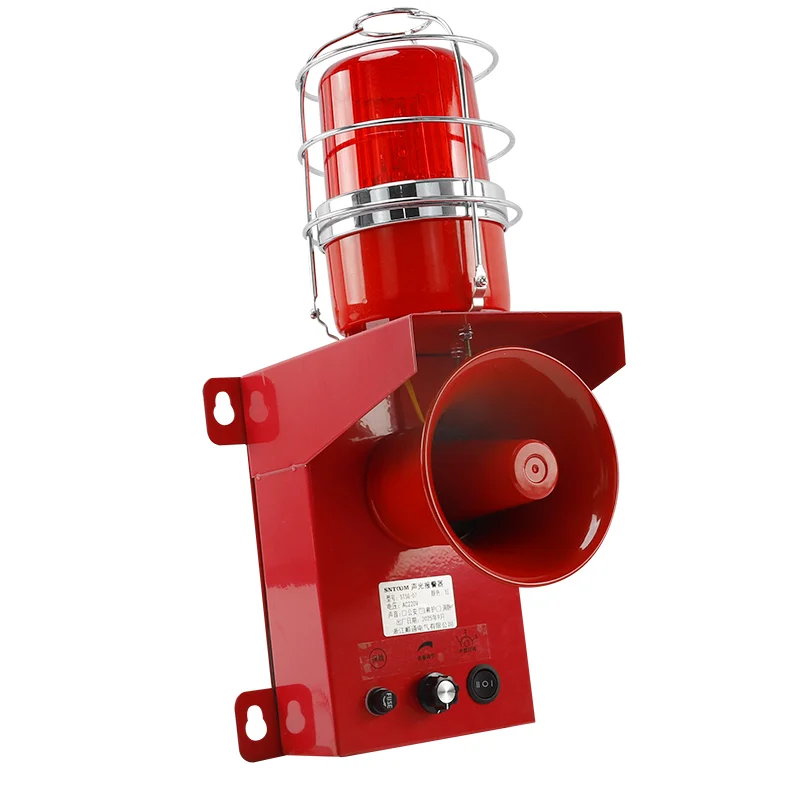
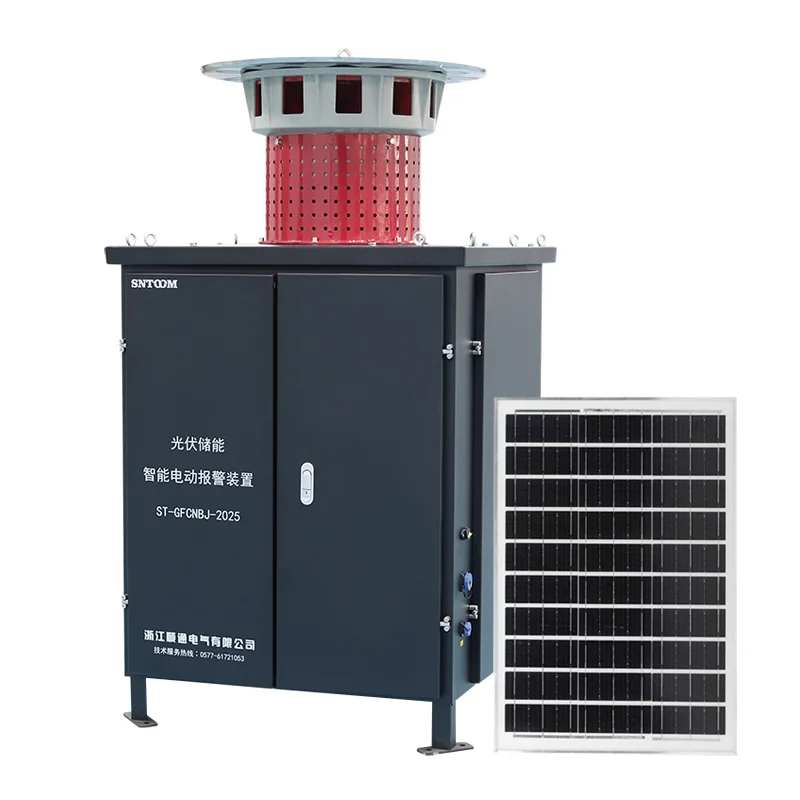
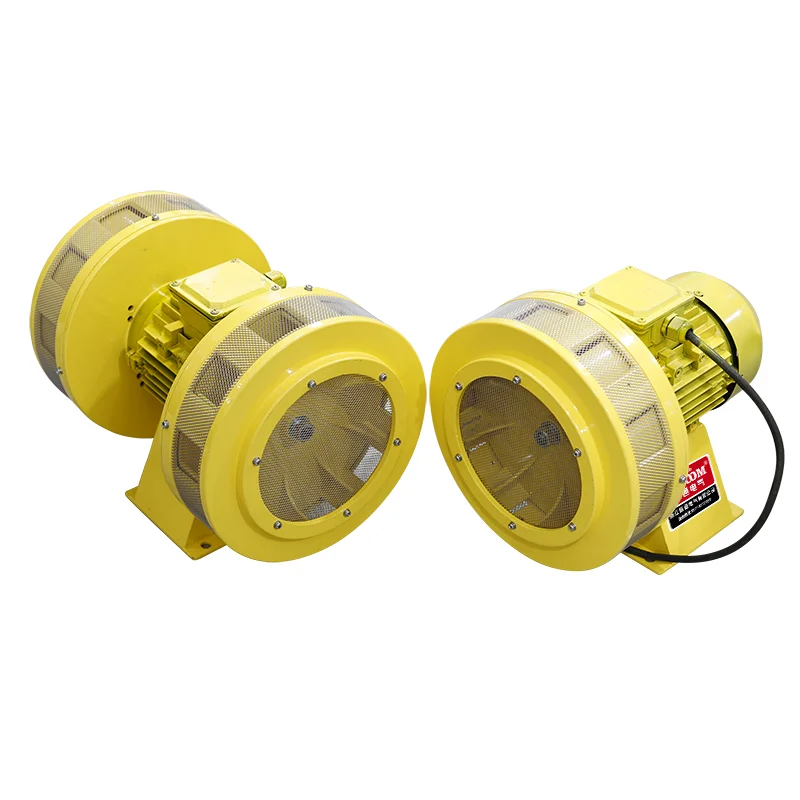
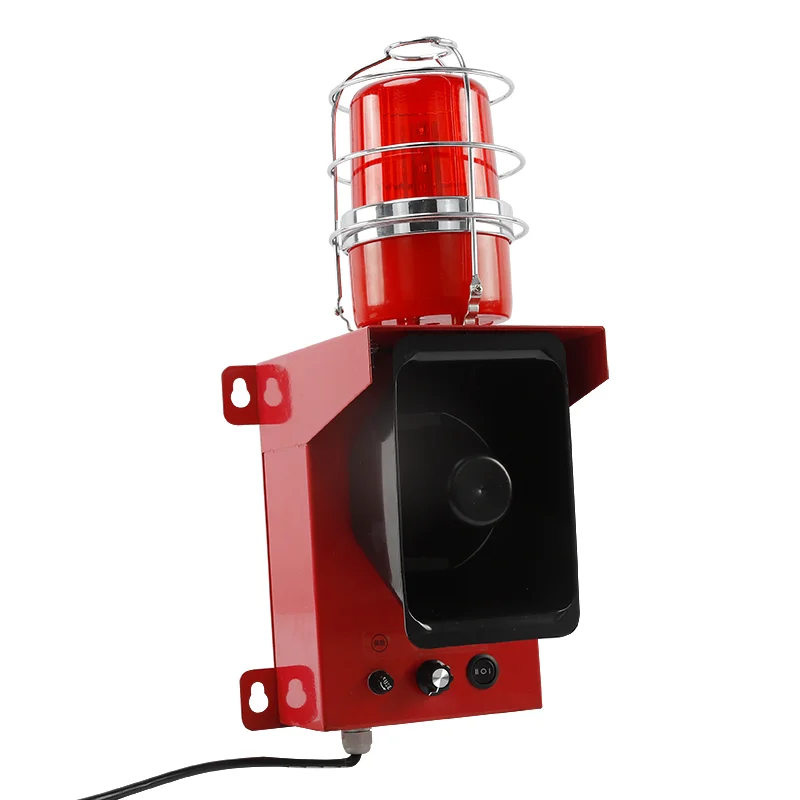
A smoke extractor is a general:purpose mechanical device that uses a power unit to drive airflow, rapidly removing smoke, harmful gases, dust, or excess heat from a space. Its core function is to improve air quality, ensure personnel safety, or meet process ventilation requirements, and it is widely used in fire protection, industrial, and civil applications.
Core Function of Smoke Extractors
Safety Assurance:In fire protection scenarios, it removes fire smoke, reduces the concentration of toxic gases, and opens up passages for rescue and evacuation; in industrial scenarios, it clears flammable and explosive gases (such as paint fumes) and dust (such as welding dust) to avoid the risk of explosions or poisoning.
Environmental Optimization:Removes cooking fumes and odors in civil applications (kitchens), reduces dust and exhaust gas concentration in industrial settings (workshops), improves the working or living environment, and some models also have a cooling function (such as industrial smoke extractors linked with ventilation for cooling).
Process Adaptation:In industrial production, it meets specific process requirements, such as smoke exhaust and cooling in high-temperature workshops and directional discharge of toxic gases in laboratories, ensuring the stability of the production process.
Core Structure of Range Hood (General Core Structure + Differentiated Design)
General Core Structure (Common to All Types)
Power System:Core Drive Unit: This includes the motor (electric type), gasoline/diesel engine (fuel-driven type), and water turbine device (water-driven type). It provides power for the impeller’s operation, and its power output determines the smoke exhaust volume and air pressure.
Impeller Assembly:Airflow Generation Component: Commonly includes centrifugal type (high air pressure, suitable for long-distance smoke exhaust) and axial flow type (high air volume, suitable for large-area smoke exhaust). Blade materials are mostly steel plate, aluminum alloy, or engineering plastics (to meet corrosion resistance and lightweight requirements).
Air Duct / Housing:A cavity that guides the direction of airflow, designed with a streamlined shape to reduce air resistance. The material is selected according to the application scenario (high-temperature resistant steel for fire protection types, corrosion-resistant stainless steel for kitchen use), and some models are equipped with noise reduction structures to lower operational noise.
Control and Safety Devices:Including switch, speed regulator (some models), overload protection (electric models), explosion-proof damper (hazardous location models), and temperature sensor (for high-temperature warning). Fire protection models additionally feature a fire grille and backfire prevention device.
Differentiated Structural Design (Adapted to Scenarios)
Equipped with a swivel bracket and a tow handle; some models feature a foot-operated angle adjuster (for adjusting the airflow direction).
For the fuel-driven model: an additional fuel tank, fuel line filter system, and muffler are installed. For the water-driven model: a high-pressure water inlet, water wheel drive disc, and filter (to prevent blockage by impurities) are provided.
Fixed Smoke Extractor (Industrial / Civil):
The industrial model is equipped with a flange connector (for easy pipeline connection and directional smoke extraction) and a shock-absorbing base (to reduce operational vibration).
The kitchen model features a grease filter, a grease collection tray, and a sealed housing design to prevent grease leakage.
Special Application Models (for Explosive/High-Temperature Environments)
The explosion-proof model uses a flameproof motor and an anti-static housing. All electrical components comply with explosion-proof standards (e.g., EX d IIB T4).
The high-temperature model features heat-resistant impellers (e.g., ceramic-coated blades) and an insulated housing, suitable for environments above 400°C (e.g., boiler flue gas extraction).
Several common types of smoke extractors
Gasoline smoke extractor
Water-driven smoke extractor
Tunnel smoke extractor
Lithium Battery Smoke Extractor
Fogging Smoke Extractor
This is the appearance of the lithium battery-powered smoke extractor for your reference.
Lithium battery-powered smoke extractor:
Working principle:
After starting the device, the lithium battery supplies power to the brushless DC motor, driving the smoke exhaust fan to rotate at high speed and creating a pressure difference in airflow. This enables the extraction or expulsion of pollutants such as smoke and toxic gases. Some intelligent models can link with environmental monitoring components. When fire or excessive combustible gases are detected, the smoke extractor automatically starts and can work in conjunction with explosion-suppressing gas or ultra-fine water mist devices to assist in explosion prevention and suppression.
Core Advantages (Precisely Tailored to Professional Scenarios):
Eco-friendly and Pollution-free + Wide Application Scenarios:Zero exhaust emissions allow safe use in confined spaces (mines, tunnels, basements) and low-oxygen environments (fire scenes), eliminating the risk of exhaust poisoning associated with gasoline-powered models, and eliminating the need for external power sources.
Portable and Efficient + Agile Operation:Without heavy components like fuel tanks and engines, the overall weight is 30%-50% lighter than gasoline-powered models. Combined with a foldable or trolley design, it allows for quick relocation by a single person, featuring one-button start and stepless speed control. No professional training required for operation
Low Noise, Low Consumption + Simple Maintenance: The brushless motor operates with significantly lower noise compared to gasoline-powered models, reducing noise pollution at work. The battery has a long cycle life, and the charging cost is merely 1/10 that of gasoline models. Additionally, there is no need for complex maintenance such as oil changes or spark plug cleaning.
Safe and Reliable + Suitable for Special Scenarios: Equipped with overcharge, over-temperature, and short-circuit protection. Some models have a waterproof rating of IP66, capable of withstanding rainy and humid environments. Certain models support intelligent linkage (e.g., synchronizing startup with gas detection devices), making them suitable for explosion-proof scenarios such as energy storage compartments and chemical workshops.
This is one of the misting smoke exhaust fans, with the image provided for reference.
Misting Smoke Exhaust Fan
Working principle:
A composite environmental protection device integrating misting dust suppression and smoke exhaust functions. Powered by an electric motor or engine, it generates micron-sized water mist through a high-pressure misting system, and combines fan airflow to achieve synergistic purification and removal of smoke and dust.
Core Advantages
Synergistic Purification: Simultaneously reduces dust while exhausting smoke, addressing the limitation of single-function smoke extractors that cannot handle dust. This improves purification efficiency by 40%-60% compared to conventional smoke extractors.
Green and Environmentally Friendly: Uses only clean water as the purification medium, with no chemical pollution, making it suitable for scenarios with high environmental requirements.
Mult-ifunctional Adaptability: Capable of smoke exhaust, dust suppression, and cooling (for summer operations), a single device meets diverse scenario requirements, reducing procurement costs.
Safe and Reliable: No exhaust emissions (for electric/battery-powered models); some fire service models feature high-temperature resistance and flame-retardant designs, suitable for high-risk environments.
This is a tunnel smoke exhaust fan. This is just one model for your reference.
Tunnel Smoke Exhaust Fan
Working principle:
The motor drives the aluminum-cast impeller to rotate at high speed, creating negative pressure that draws toxic gases, smoke, and other pollutants from confined spaces into the air duct, which are then expelled through the duct.
Core Advantages:
High Smoke Exhaust Efficiency: Airflow generally exceeds 1200 m³/h, with some models reaching up to 2880 m³/h. It can quickly remove smoke and hazardous gases (such as methane and dust) from tunnels, shortening the time required for personnel evacuation and resumption of operations.
Portable and Easy to Operate: Most units weigh less than 20 kg overall. Some feature an integrated portable design with a built-in power source or quick-connect interface, requiring no complicated installation. A single person can easily transport and deploy the unit.
Strong Environmental Adaptability: The body is made of steel and corrosion-resistant materials, able to withstand impacts, dampness, and other harsh conditions in tunnels. The motor and impeller structure are designed to match the airflow characteristics of confined spaces, making them less prone to malfunctions.
Safe and Low Noise: Noise is controlled around 78 dB, avoiding secondary interference during operation. Some models are equipped with overload and leakage protection, complying with tunnel explosion-proof and safety regulations.
Multi-functional Adaptability: Can be paired with air ducts to extend the smoke extraction range, enabling both smoke exhaust and ventilation. Suitable for various enclosed scenarios such as tunnel construction, mine rescue, and underground engineering.
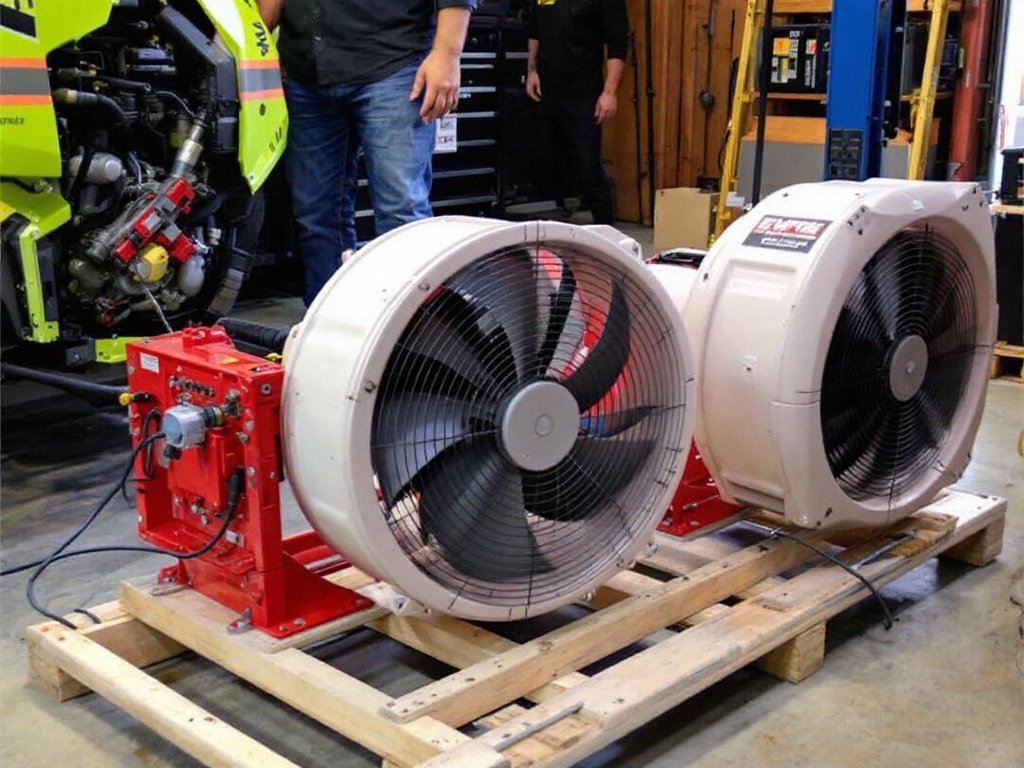
This one is the gasoline model. It looks a bit like the water-driven model from the front, so take a look at the structure of the back.
Gasoline smoke exhaust fan
Working principle:
After the gasoline engine is started, it drives the centrifugal/axial impeller inside the unit to rotate at high speed through the transmission mechanism. The impeller rotation creates negative pressure (making the air pressure at the inlet end lower than the outside), thereby sucking smoke and toxic gases into the unit.Meanwhile, the impeller works on the gas, giving it kinetic energy and pressure energy, and expels it at high speed from the exhaust port.By creating a pressure difference between the intake and exhaust ports, a continuous and directional airflow is formed, enabling rapid smoke exhaust and ventilation.
Core Advantages:
Exceptional Independence and Mobility This is its most fundamental advantage. It requires no external power source, air supply, or hydraulic lines, being a self-contained power unit. It can be started and operated immediately at any location and time (including power outages, remote areas, disaster sites) simply by refueling. This grants it unparalleled flexibility in emergency rescue, fieldwork, agriculture, and other domains.
High Power and High Airflow/Static Pressure Output Gasoline engines can provide very high power (commonly ranging from a few to several tens of horsepower), enabling them to drive large-diameter impellers at high rotational speeds. This results in extremely high air velocity (can exceed 100-150 m/s) and massive air volume (tens of thousands of cubic meters per hour). This level of powerful airflow is difficult for most portable electric fans to match.
Rapid Deployment and Simple Operation Featuring a compact, integrated design and typically equipped with carrying handles, shoulder straps, or wheeled frames, it can be quickly transported to the target location by 1-2 personnel. Operation usually involves only a few steps: refueling, opening the choke, and pull-starting (or electric starting) to run at full power. No complex preparation is needed.
Excellent Environmental Adaptability Tolerance of Harsh Conditions: Air-cooled engines adapt well to high-temperature environments and are not susceptible to moisture (though attention must be paid to waterproofing electrical components). Ruggedness: The sturdy construction can withstand a certain degree of vibration and impact, making it suitable for use in chaotic rescue scenes or construction sites.
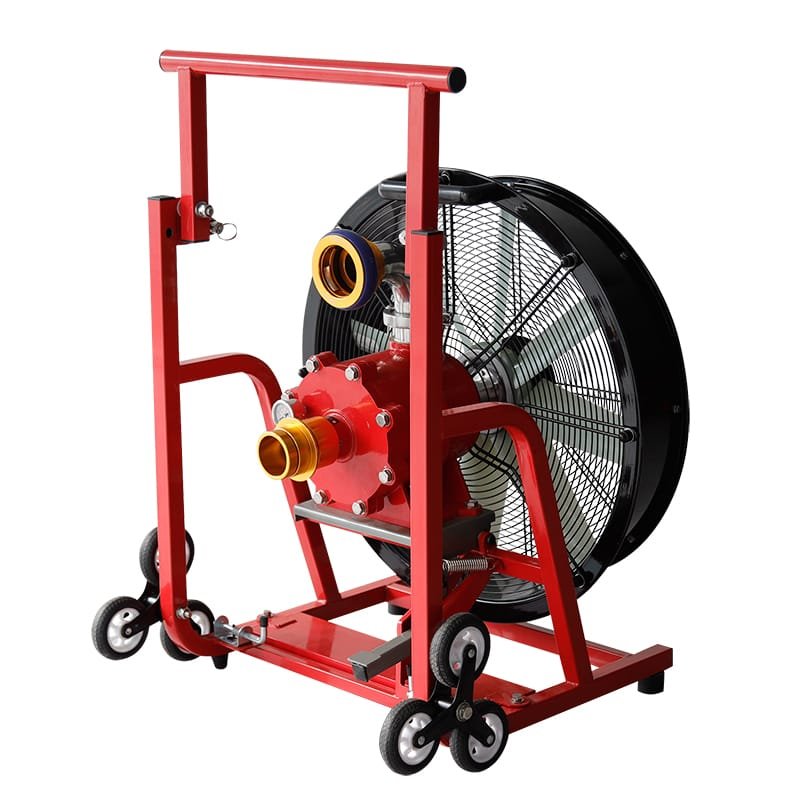
This is the water-driven smoke extractor. The front looks similar to other models, so the back is provided for reference.
Water-driven smoke extractor
Working Principle:
High-pressure water source (such as fire hoses or high-pressure water pumps) supplies high-pressure water flow to the built-in water turbine of the device. The water flow strikes the turbine blades, causing them to rotate at high speed. Through the transmission mechanism, the centrifugal impeller inside the unit rotates synchronously. The impeller rotation creates a pressure difference between the air inlet (negative pressure) and the exhaust outlet, drawing in smoke and harmful gases, then expelling them at high speed to achieve rapid ventilation.
Core Advantages:
Core Advantage of Explosion-Proof Safety: No motor, no circuit, and no electric spark generation, fundamentally avoiding ignition risks. It is an exclusive safe smoke exhaust equipment for flammable and explosive environments such as oil depots, chemical workshops, and gas leakage sites.
Strong Environmental Adaptability: Resistant to high and low temperatures (-20℃~60℃), humidity, and dust. It does not rely on power supply and can work stably in non-powered scenarios such as mines, tunnels, and field rescues, or in environments with humidity and corrosive gases.
Portable and Easy to Operate & Maintain: The body is made of lightweight alloy material, equipped with mobile wheels and a foldable handle for quick deployment by a single person. It requires no complex maintenance such as engine oil replacement or circuit inspection—only regular cleaning of the impeller and water turbine, ensuring a long service life.
Stable Smoke Exhaust Efficiency: Driven by high-pressure water flow, the impeller rotates at a uniform speed, providing a continuous and stable air volume (8000-18000m³/h) without being affected by voltage fluctuations. It is suitable for long-term continuous smoke exhaust operations.
The working principles, pictures, and core advantages of several types of smoke extractors are all included in the article, and I hope it will be helpful for choosing a smoke extractor.
Working Principle of Voltage Regulator Voltage regulator are essential components in electronics, ensuring that devices receive a consistent voltage supply. This is crucial for devices like car batteries, home outlets, and cell phones, which require specific voltages to function efficiently. Voltage fluctuations, often caused by factors such as power grid conditions, appliance usage, or environmental […]
We use cookies to enhance your browsing experience, serve personalised ads or content, and analyse our traffic. By clicking "Accept All", you consent to our use of cookies.