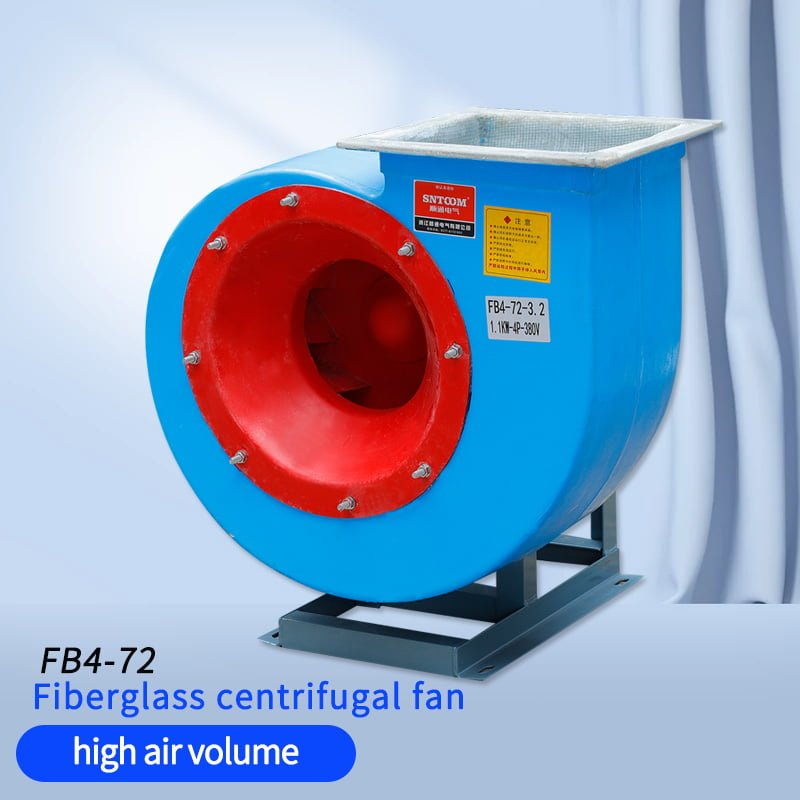
Centrifugal Fans
What Is the Static Pressure of a Centrifugal Fan
Discover what static pressure is in centrifugal fans and how it affects fan performance and efficiency.
Read More
Are you confused about the difference between centrifugal fan and impeller fans? Many people use these terms interchangeably, but they are actually quite different.
Not understanding the key differences can lead to choosing the wrong fan for your application, resulting in suboptimal performance, higher energy costs, and even potential equipment damage.
In this post, we’ll clarify the distinct characteristics of centrifugal and impeller fans, including their pressure capabilities, airflow direction, efficiency, noise levels, durability, cost, and typical applications.
A centrifugal fan is a mechanical device designed to move air or other gases by utilizing centrifugal force. It consists of an impeller, which is a rotating disc with blades attached radially. As the impeller spins, it draws air into the center and accelerates it radially outward, creating a flow of air perpendicular to the shaft. The centrifugal force generated by the rotating impeller increases the kinetic energy and pressure of the air, allowing it to be discharged from the fan housing.
An impeller fan, also known as an axial fan, is a type of fan that propels air or gases in a direction parallel to the shaft on which the blades rotate. It consists of a central hub with blades attached to it, resembling a propeller. As the impeller rotates, it creates a pressure difference that causes air to flow along the axis of rotation.
Centrifugal fans are capable of generating higher pressures compared to impeller fans. The centrifugal force created by the rotating impeller allows centrifugal fans to overcome significant resistance to airflow, making them suitable for applications that require air to be moved through ducts, filters, or other obstructions.
Impeller fans are better suited for applications with low resistance to airflow, as they generate lower pressures.
In centrifugal fans, air enters the impeller axially and is discharged radially, perpendicular to the shaft.
Impeller fans move air in a direction parallel to the shaft, with air entering and exiting the fan along the same axis.
Impeller fans are generally capable of moving larger volumes of air compared to centrifugal fans of similar size. The axial flow design of impeller fans allows for a higher flow rate, making them suitable for applications that require significant air movement, such as cooling large spaces or equipment.
Centrifugal fans, while capable of moving substantial air volumes, are more focused on overcoming resistance and generating higher pressures.
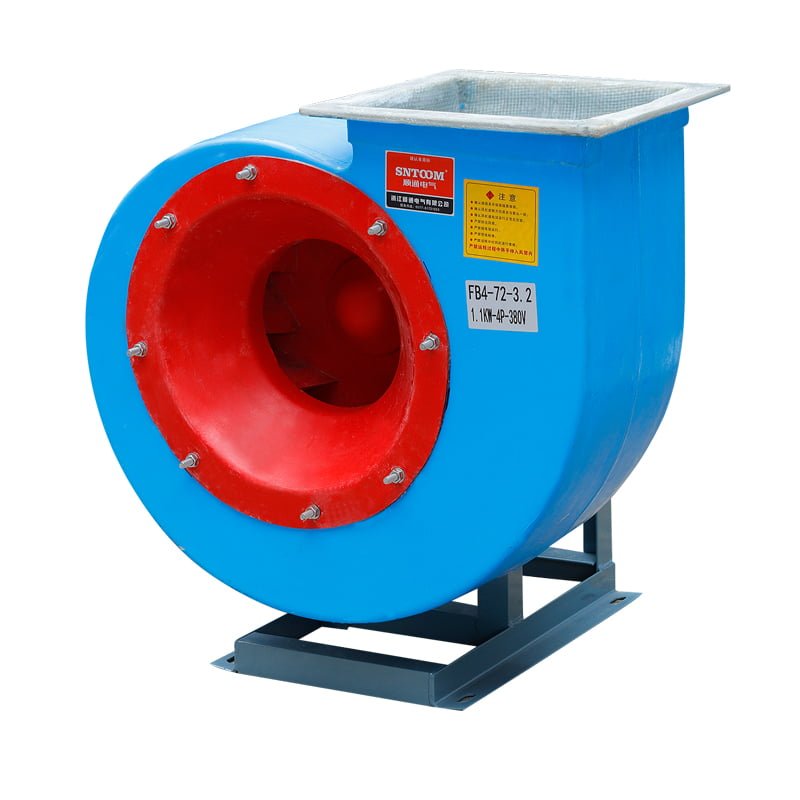
We offer custom Centrifugal fan services and free technical guidance. Contact us today to help you improve your factory’s ventilation efficiency!
Centrifugal fan with backward-curved or airfoil blades tend to have higher efficiencies compared to those with forward-curved blades.
Impeller fans can achieve high efficiencies when operating at their optimal design point, but their efficiency may decrease when faced with system resistance.
Centrifugal fans generally produce less noise compared to impeller fans of similar size and airflow capacity. The radial discharge of air in centrifugal fans allows for more effective noise attenuation through the use of scroll housings and duct silencers.
Impeller fans, with their axial flow design, can generate higher noise levels, particularly at high operating speeds.
Centrifugal fans with robust impeller designs and well-balanced components can withstand continuous operation and moderate levels of dust or debris.
Impeller fans, especially those with plastic or lightweight blades, may be more susceptible to damage from impact or excessive vibration.
Centrifugal fans with complex scroll housings and high-efficiency motors may have higher initial costs compared to impeller fans of similar airflow capacity.
FB-72 Centrifugal fan are commonly used in applications that require high pressures, such as:
Impeller fans are typically used in applications that require high airflow rates with low resistance, such as:
A centrifugal fan uses a larger, enclosed impeller with blades that push air outward through a scroll housing, while an impeller fan typically has a smaller, simpler impeller that moves air directly without a housing.
Centrifugal fans generate higher pressure and move air at right angles to the inlet, suited for ducted systems. Impeller fans create lower pressure and move air mostly in a straight line, ideal for free-blowing applications.
They are used in HVAC systems, industrial exhaust, and applications requiring air to be moved through ducts or filters.
Impeller fans are used where airflow is needed without resistance, like cooling electronic components or ventilation in open spaces.
Centrifugal fans tend to be more energy-efficient for high-pressure needs, while impeller fans are efficient for low-pressure, high-volume airflow.
Centrifugal fans often generate more noise due to higher pressure operation, whereas impeller fans usually run quieter in low-resistance environments.
Yes, their enclosed design and higher pressure make centrifugal fans better suited for environments with dust and particulate matter.

Discover what static pressure is in centrifugal fans and how it affects fan performance and efficiency.
Read More
Learn how to easily calculate the CFM (cubic feet per minute) of a centrifugal fan using simple measurements.
Read More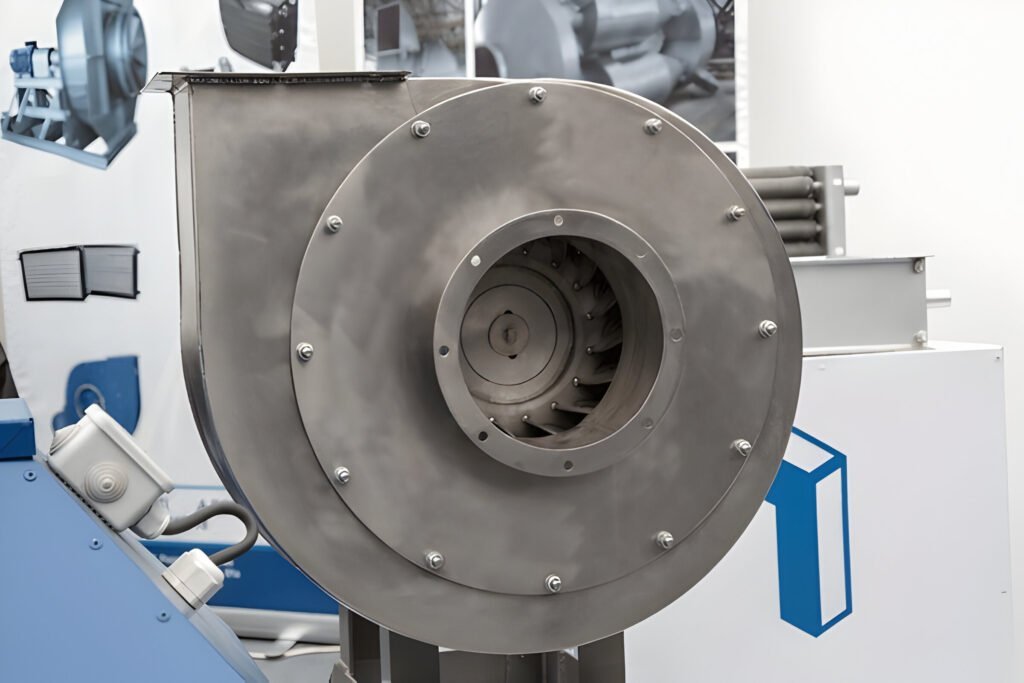
Centrifugal and radial fans differ in blade design, airflow patterns, and applications, despite their similar appearance.
Read More