On-Load Tap Changing Transformers: How to Read a Tap Position Table
A transformer nameplate states one voltage ratio, but the network it feeds rarely stays at one voltage. Load moves through the day, feeders are switched, and the point of connection drifts. An on-load tap changing transformer exists to absorb that drift. The section that tells you how much correction is available is the tap position table, and it is the part most buyers skim past.

Here is the content list:
- What an on-load tap changing transformer actually does
- Reading a tap position table line by line
- On-load versus off-circuit tapping
- What to put on the enquiry
What an On-Load Tap Changing Transformer Actually Does
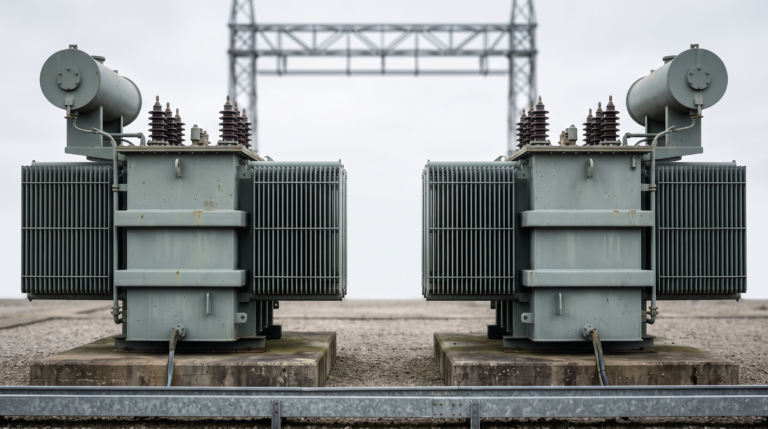
The high-voltage winding carries a series of tappings. A diverter switch inside the on-load tap changing transformer selects which tapping is in circuit while the unit stays live and carries load. That changes the turns ratio, so the secondary voltage moves up or down with no interruption to supply.
The idea is simple, and it helps to separate it from two neighbors. A voltage stabilizer corrects an unstable supply at the point of use. An on-load tap changing transformer corrects the ratio at the point of transformation, upstream of everything downstream. The second is a network asset, sized once and expected to serve for decades.
Because the diverter switch operates under load, it carries a maintenance burden. Contacts erode, oil in the diverter compartment degrades faster than main tank oil, and the mechanism needs inspection on a schedule. That cost is the price of regulating without a shutdown.
Reading a Tap Position Table Line by Line
A tap position table looks like a spreadsheet, and it rewards being read like one. Take a 3150 kVA unit stepping 35 kV down to 10.5 kV with a ±4×2.5% range. The tap position table has nine rows, one per physical position of the diverter switch.
Start with the rated row. It is normally marked, and it is the only row that prints rated currents. Everything else follows from it.
- Tap 5, rated: 35000 V on the high side, 51.96 A high side, 10500 V and 173.2 A on the low side.
- Tap 1: 38500 V, ten percent above rated, giving the lowest secondary voltage for a given primary.
- Tap 9: 31500 V, ten percent below rated, giving the highest secondary voltage.
- Intermediate rows: 37625 V, 36750 V, 35875 V above rated; 34125 V, 33250 V, 32375 V below it.
Two facts fall out of that tap position table. The step is 875 V, which is 2.5 percent of 35000 V, and nine positions at that step span the full ±10 percent. Current appears only in the rated row because it scales inversely with voltage, so every other row follows by proportion.
Read the low-voltage column of the tap position table the same way. Here it holds at 10500 V across all nine positions, which tells you tapping sits on the high-voltage winding alone. If that column also stepped, you would be looking at a different arrangement and should ask why.
On-Load Versus Off-Circuit Tapping
Not every unit needs a diverter switch, and paying for one where it is not needed is a common overspend. An off-circuit tap changer is often the honest answer. The range in the tap position table usually settles which one you need.
An off-circuit tap changer is cheaper, smaller and nearly maintenance free, but it can only be moved with the transformer isolated. It suits a unit set once at commissioning against a known network voltage and then left alone, which is exactly what a narrow tap position table describes. A distribution transformer on a stable feeder is the classic case.
An on-load tap changer earns its cost where voltage moves while load is live and a shutdown is refused. Think of an OLTC transformer feeding a plant that cannot stop, or a network whose point of connection swings daily. On-load voltage regulation also lets an operator correct seasonal drift without sending a crew.
The practical test is short. If the operating procedure already allows planned outages, an off-circuit tap changer will do. If nobody can schedule an outage, specify the on-load tap changing transformer and budget for its maintenance.
What to Put on the Enquiry
Most quotation delays come from a specification that never states the tap range, so the tap position table is left to the supplier. The supplier then quotes a default, and the default is rarely what the network needed.
- State rated capacity, voltage ratio and vector group together, because they are read as one set.
- Give the tap range as a percentage and a step, for example ±4×2.5%, not as a list of voltages.
- Say whether tapping is on the high-voltage or low-voltage winding.
- Name the cooling method and the operating condition, indoor or outdoor.
- Ask for the tap position table itself, not only the headline ratio, so the full range can be checked before the order.
An OLTC transformer is a long-lead item, and a wrong tap range is costly to correct once the tank is sealed. Putting the tap position table on the enquiry costs nothing.
Closing
A tap position table is not decoration. It states regulation range, step size, the winding that is tapped and the currents that follow, and it is the fastest way to check whether a quoted OLTC transformer covers the network it will serve.
Zhejiang Shuntong Electric has more than 30 years of experience in manufacturing oil-immersed power transformers, on-load voltage regulation equipment and low-voltage switchgear, and can confirm tap range, vector group and cooling arrangement against your network conditions before production begins.