The Honest Load List: What 1000 W Really Runs Off 48 V
The question arrives in almost the same words every time: "I have a 48 V battery bank and I am looking at a 1000 W inverter. Can it run my fridge, my pump, my coffee machine and my tools?" The honest answer is not a yes or a no. It is a list, because the equipment that fails on a 1000 W unit rarely fails for lack of watts. It fails because of what happens in the first second, or because the battery was already low, or because four modest loads were added together and nobody did the addition.
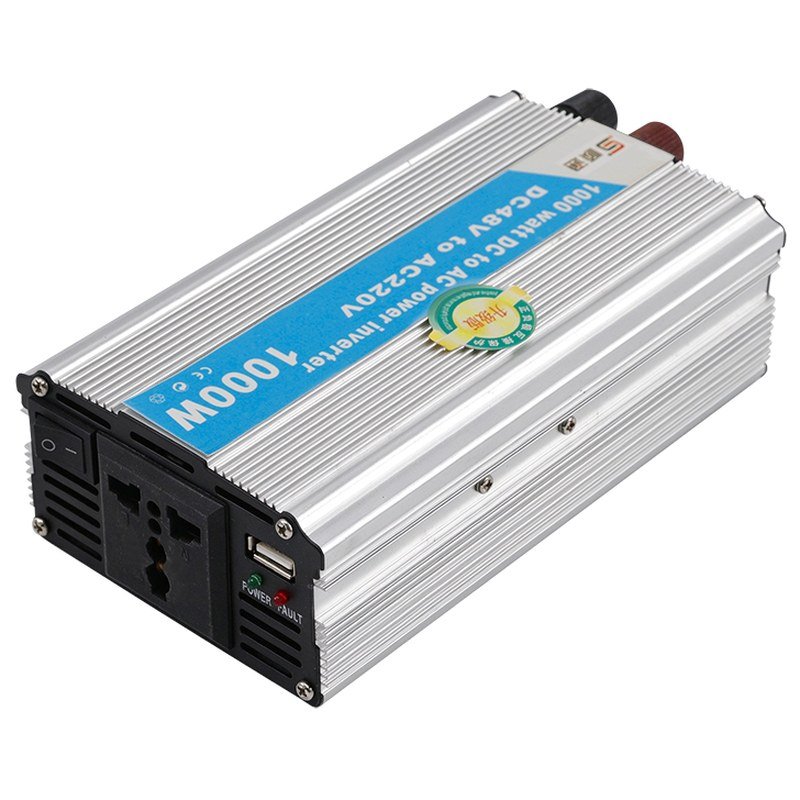
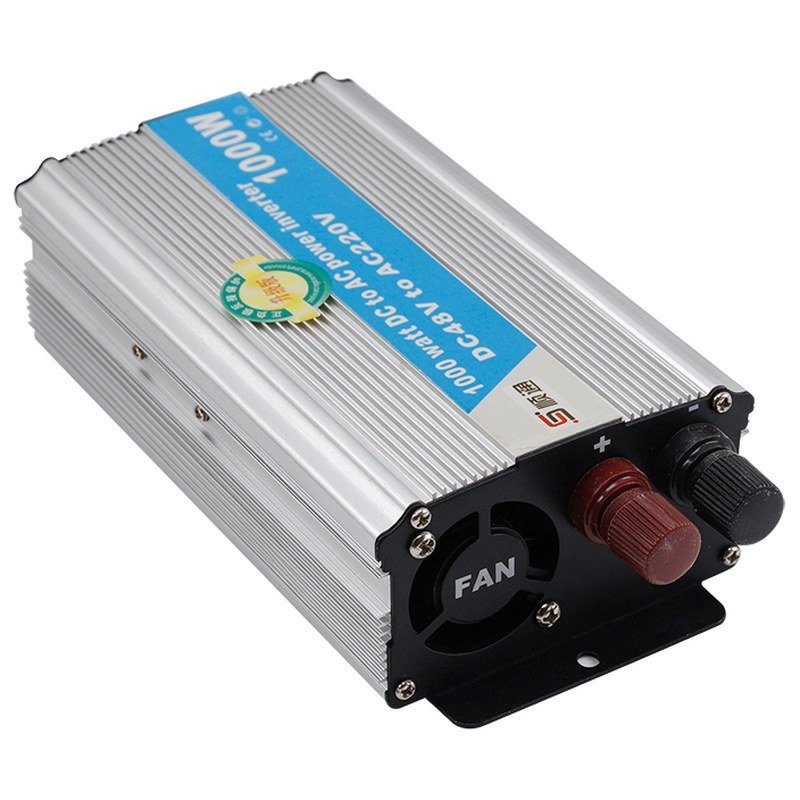
So this is a load list, written the way an installer would write it on the back of a job sheet: one load at a time, with the running watts, the start watts, the practical verdict, and the arithmetic that produced it. The reference unit is the 1000 W continuous, 2000 W peak, DC 48 V to AC 220 V model with a modified sine wave output, a universal socket and one USB port. Where a load sits near the boundary, the article says so rather than pretending the margin is comfortable.
Here is the content list:
- Why 48 V changes the answer before any load is discussed
- The three numbers that decide every verdict
- How to build a load list you can actually trust
- Lighting, chargers and small electronics
- Refrigeration: the compressor test
- Pumps and water systems
- Power tools and the workshop bench
- Kitchen loads, and the four that never work
- A small shop or kiosk running on battery power
- Fans, heaters and seasonal equipment
- Vehicle, boat and campsite duty
- Where the edges are: 900 W loads, long cable runs, cold batteries
- A day in watt-hours: three worked examples
- When 1000 W is the wrong answer
- Habits that keep an off-grid installation alive
Why 48 V Changes the Answer Before Any Load Is Discussed
At 1000 W, the DC current is roughly 21 A at 48 V, 42 A at 24 V and 83 A at 12 V before efficiency losses are counted. That single difference decides how much of the installation budget goes into cable, fuses and connectors, and how much voltage sag the power inverter has to tolerate when a compressor kicks in. A 12 V system at this power level is a cable problem wearing an inverter's clothes; a 48 V system is a wiring job that fits in one afternoon.
There is a second consequence that matters more in practice. A 48 V battery bank made of four 12 V blocks in series, or sixteen lithium cells in series, stores the same energy as an equivalent 12 V bank with four times the ampere-hour rating, but it delivers that energy at a quarter of the current. Lower current means less heat in the terminals, less drop along the run, and a smaller share of the stored energy lost before it reaches the AC side. Off-grid installations that start at 48 V tend to stay at 48 V for exactly this reason.
The trade-off is that 48 V DC is not a voltage to treat casually. It is above the usual safety-extra-low-voltage band, so insulation, fusing, polarity discipline and a proper DC isolator are not optional extras. Anyone who is comfortable wiring a 12 V camper system should still read the 48 V section of the manual before connecting a battery bank of this size.
The Three Numbers That Decide Every Verdict
Every appliance has three numbers that matter, and most buyers know only the first. Running watts come from the nameplate or the manual. Start watts are the brief inrush that a motor or a compressor draws while it accelerates, and they are rarely printed anywhere. Daily watt-hours are what the load list must finally add up to, because a load that fits within 1000 W can still empty a battery bank by midnight.
The rules that follow from those three numbers are consistent:
- Running watts must fit under 1000 W with margin left for everything else that is on at the same time
- Start watts must fit inside the 2000 W peak window, one motor at a time
- Daily watt-hours must fit inside what the battery bank can deliver and what the charging source can replace
- Efficiency and standby losses belong in the arithmetic, not in a footnote
A fourth rule is less obvious: the shape of the output matters. A modified sine wave suits resistive loads and universal motors, and it suits most switch-mode power supplies, but it does not suit every device with an electronic controller. When a load is marginal on waveform rather than on watts, no amount of extra capacity will fix it.
How to Build a Load List You Can Actually Trust
The reliable method is boring and takes twenty minutes. Walk the site with a notebook, write down every appliance that might be plugged in, and record the nameplate watts, the hours per day and whether it has a motor. Then add a 20 % margin for the loads nobody writes down: the phone charger, the radio, the light in the shed.
A load list built this way produces four columns and a total:
| Load | Running watts | Start watts | Hours per day |
|---|---|---|---|
| LED lighting, six fittings | 60 | 60 | 5 |
| Laptop and router | 90 | 90 | 8 |
| Refrigerator, 150 L | 120 | 550 | 8 (cycling) |
| Water pump, 0.5 hp | 370 | 1100 | 1 |
| Hand tools, intermittent | 500 | 900 | 1 |
| Phone and torch charging | 30 | 30 | 3 |
The total running load in that table is 1170 W if everything is on at once, which is over the rating — and this is where most installations go wrong. Nothing in the list is unreasonable; the mistake is simultaneity. Managed properly, the pump runs while the fridge is off its cycle and the tools are put away, and the peak simultaneous load stays near 600 W. A load list is therefore a schedule as much as a list, and the discipline of not starting everything at once is part of the specification.
Lighting, Chargers and Small Electronics
This is the easy half of the list, and it is where a 48 V system earns its keep. LED lighting, phone and laptop chargers, a router, a small television, a radio and a torch charger together rarely exceed 200 W, and they tolerate a modified sine wave without complaint. The USB port on the power inverter covers the phone and tablet case without an adapter, which matters in a vehicle where socket space is scarce.
Two details are worth knowing. First, cheap LED lamps with capacitive droppers occasionally flicker on a stepped waveform; if that happens, replace the lamp rather than the power inverter. Second, laptop power supplies are wide-input switch-mode units and usually run warm but fine; an older linear supply with a heavy transformer is less happy and may hum audibly.
For a cabin or a kiosk, this block of loads is what runs every evening, so it belongs at the top of the daily watt-hour total. Sixty watts of lighting for five hours is 300 Wh; a laptop and router for eight hours is 720 Wh. Those two lines alone are about a quarter of a small battery bank's usable capacity, which is why lighting efficiency pays for itself faster than any other change on site.
Refrigeration: The Compressor Test
A modern 150 litre refrigerator draws roughly 100 to 150 W while the compressor runs, and it runs perhaps a third of the time in a cool room. The running load is comfortable. The start is the event that decides whether the installation works: a compressor can pull several hundred watts for a fraction of a second, and a power inverter that cannot supply that surge will trip and reset in a loop that sounds like a click every few minutes.
Against a 2000 W peak window, a domestic fridge is normally within reach. The practical test takes ten minutes: connect the fridge alone, let it start three times, and watch the indicator. If the green lamp holds through three starts and the compressor settles into its normal cycle, the surge power is adequate. If the red lamp appears even once, the compressor is outside the window and no other adjustment will change that.
Two habits extend compressor life on battery power. Keep the fridge full, because thermal mass reduces cycling, and give it shade and ventilation, because a compressor in a hot cabinet runs longer and draws more. A fridge that cycles twice as often in summer will quietly consume twice the daily watt-hours that were budgeted in spring.
Pumps and Water Systems
Water pumping is the load class where a 1000 W unit is most often misapplied, because pump nameplates are written in horsepower and buyers convert badly. A 0.5 hp motor is about 370 W of shaft power, and its starting current can be several times that. A 1 hp pump at 750 W running is close to the ceiling of the power inverter and its start will usually exceed the peak allowance.
The realistic envelope for this class of power inverter:
- Small circulation pumps and low-head transfer pumps generally start and run
- A 0.5 hp pressure pump can work if it starts unloaded, or with a soft starter
- A 1 hp submersible pump needs a larger frame or a dedicated pump inverter
- Two pumps starting together will trip a power inverter that handles either one alone
If the site depends on a pump, the honest approach is to measure rather than estimate. A clamp meter on the pump's supply while it starts tells you more than any nameplate, and it takes less time than returning a power inverter that was specified from a catalogue.
Power Tools and the Workshop Bench
Hand tools are the friendliest motor loads on a battery system: they run intermittently, they are usually universal motors with brushes, and they tolerate a modified sine wave. A drill, an angle grinder, a jigsaw and a small circular saw can each run from a 1000 W unit as long as they are used one at a time and the saw is not pushed into hardwood at full depth.
The bench tools that cause trouble are the ones with continuous duty and high inertia: a bench grinder, a table saw with an induction motor, a compressor. Those are the loads that need to be started unloaded, and even then the margin is thin. A workshop that runs a table saw all afternoon is a workshop that needs a generator, not a battery.
There is also a dust question that has nothing to do with watts. A workshop installation puts abrasive dust into the fan and the fin stack, and a power inverter mounted at bench height will collect it. Mount it high, or in a filtered enclosure, and clean the fins on the same schedule as the tools.
Kitchen Loads, and the Four That Never Work
Kitchen appliances divide cleanly into those that fit and those that do not, and the dividing line is almost always the heating element.
Loads that usually work: a small coffee maker (600 to 800 W), an electric kettle up to about 900 W, a blender, a rice cooker on a low setting, a microwave only if its rated input is under the ceiling. Each of these is resistive and therefore waveform-tolerant, which is a genuine advantage of a modified sine wave output.
Loads that do not work, regardless of how the marketing reads:
- A full-size kettle or urn at 1500 to 3000 W, which is simply above the continuous rating
- An induction hob, which needs a clean waveform and a much larger supply
- A toaster and a coffee machine started together, which adds up to more than either suggests
- A combination microwave that pulls well over its cooking rating on grill or convection
The pattern is worth stating plainly for anyone specifying a system for a rental cabin: if the guests expect to boil a full kettle while the fridge is running, the installation needs more capacity than 1000 W, and no amount of careful scheduling will fix it at breakfast time.
A Small Shop or Kiosk Running on Battery Power
A kiosk is a better match for this power level than a kitchen, because the loads are electronic and modest. A point-of-sale terminal, a receipt printer, a router, two lights, a card reader and a small display typically total 200 to 400 W, and they run during trading hours rather than around the clock.
The critical detail in a shop is not the total but the continuity. A till that loses power mid-transaction is worse than a till that never opened, so the installation needs a battery bank sized for the full trading day plus the standby drain of the unit itself, and a charging source that can refill it before the next morning. Shops that run this way usually add a small uninterruptible supply for the till and leave the power inverter to carry the rest.
Cooling is the second consideration. A kiosk in summer needs a fan, and a fan is an easy load; a kiosk that needs air conditioning is outside this class entirely. Signage is usually LED and negligible, but an old fluorescent sign with a magnetic ballast is not, and it will also buzz on a stepped waveform.
Fans, Heaters and Seasonal Equipment
Fans are the most forgiving motor load on the list. A pedestal fan, a ceiling fan without electronic speed control, and a workshop fan all start easily and draw little. Variable-speed fans with remote controls and electronic commutation are a different matter: they often expect a sine wave and may refuse to start or run at the wrong speed.
Heaters are resistive, so they are waveform-tolerant, and the only question is watts. A 500 W panel heater or a 600 W greenhouse heater fits; a 2000 W fan heater does not, and no schedule makes it fit. For a cabin in winter, the sensible arrangement is a small resistive heater on the power inverter and a fuel-based heater for bulk warmth, because heating with stored electricity is the most expensive way to stay warm.
Seasonality deserves a line in the load list of its own. A summer installation that runs fans and a fridge looks comfortably within capacity, and the same installation in winter with a heater added can exceed it. The number that matters is the worst week of the year, not the average.
Vehicle, Boat and Campsite Duty
In a vehicle, the loads are small and the constraints are mechanical: where the power inverter is mounted, how the cable reaches the battery, and whether the socket fuse becomes the limiting component. A 48 V pack in a camper is unusual but increasingly common in converted vans with a 48 V lithium bank, and the same rules apply — short cable, fused at the battery, isolated when parked for weeks.
On a boat, the corrosive atmosphere is the enemy rather than the load. Terminals need protection, the enclosure needs to be clear of bilge water, and the power inverter should be mounted where spray does not reach it. A 1000 W unit will happily run a small fridge, lights, a laptop and a radio for a weekend; it will not run an electric hob, and boat cooks who try usually end up with a gas backup anyway.
At a campsite, the load list shrinks to lights, chargers, a small fridge or cooler and perhaps a coffee maker. This is the use case where a 1000 W unit with a universal socket and a USB port is genuinely well matched, and where the off-grid experience is pleasant rather than marginal.
Where the Edges Are: 900 W Loads, Long Cable Runs, Cold Batteries
Three conditions turn a comfortable installation into a marginal one, and all three are common.
A load at 900 W leaves 100 W of headroom, which is less than it sounds once the fridge starts or the fan comes on. Treat anything above 800 W as a load that needs to run alone.
A long cable run erodes the margin from the DC side. Twenty metres of undersized cable at 21 A can drop enough volts that the power inverter sees undervoltage under load, and the symptom looks exactly like a weak battery. Measure at the terminals, not at the battery.
Cold weather reduces what a lead-acid battery bank can deliver, sometimes sharply, and it also affects lithium packs at the lower end of their range. A bank that carries the load at 20 °C may not carry it at 2 °C, which is precisely when the heater is also on.
A Day in Watt-Hours: Three Worked Examples
The daily total is where an installation succeeds or fails, and three worked examples cover most of the cases that reach a supplier's inbox.
Example one, a weekend cabin: 60 W of lighting for 5 hours (300 Wh), a laptop and router at 90 W for 8 hours (720 Wh), a fridge averaging 40 W across the day (960 Wh), and the standby drain of the power inverter if it is left on (about 345 Wh). Total is roughly 2.3 kWh of AC energy, which at 90 % efficiency asks about 2.6 kWh from the battery bank.
Example two, a kiosk: 300 W for 10 trading hours is 3 kWh, plus 200 Wh of standby, plus a fan at 50 W for 6 hours (300 Wh). About 3.5 kWh of AC energy, or 3.9 kWh from the battery bank. That is a two-battery 48 V lithium installation, not a single block.
Example three, a workshop day: tools at 500 W for 90 minutes (750 Wh), lighting at 100 W for 4 hours (400 Wh), a compressor cycling for 20 minutes at 800 W (267 Wh) and a radio all day (100 Wh). About 1.5 kWh, comfortably inside a modest bank, provided the compressor start fits the peak window.
In each case the arithmetic is the same four steps: list the loads, multiply watts by hours, divide by efficiency, then compare with usable capacity after the depth of discharge you are willing to accept.
When 1000 W Is the Wrong Answer
There are honest situations where this power level is the wrong purchase, and saying so early saves everyone a return shipment.
- The load list contains a kettle, a water heater, an air conditioner or an induction hob
- Two or more large motors must start together
- The site has no charging source that can replace a multi-kilowatt-hour daily draw
- The equipment includes audio, medical or precision instruments that need a clean waveform
- The installation must run unattended for weeks without supervision
In those cases the answer is a larger frame, a pure sine wave model, or a generator, and the load list makes the choice obvious. A supplier who asks for the load list before quoting is doing the buyer a favour.
Habits That Keep an Off-Grid Installation Alive
The equipment is the cheap part of reliability. The habits are what keep an installation running for years.
- Switch the power inverter off when nothing is using it, and fit a DC isolator for long absences
- Clean the fan and the fin stack every season, especially in dusty or coastal locations
- Re-torque the DC terminals after the first week, then check them annually
- Keep the battery bank ventilated and above its cold-weather limit
- Record the daily watt-hours for a month, because measured consumption is always different from the estimate
- Start large motors one at a time, and never assume the next person will
Zhejiang Shuntong Electric has more than 30 years of experience in manufacturing electrical power equipment for industrial and commercial users. Send us the load list, the battery chemistry and the daily hours, and we will tell you whether the 1000 W DC 48 V to AC 220 V frame covers the duty or whether the honest answer is a larger unit. The model described here carries a universal socket and a USB port, delivers 1000 W continuous and 2000 W peak from a 48 V battery bank, and is intended for exactly the kind of load list this article has just walked through — provided the list is written before the purchase rather than after.