
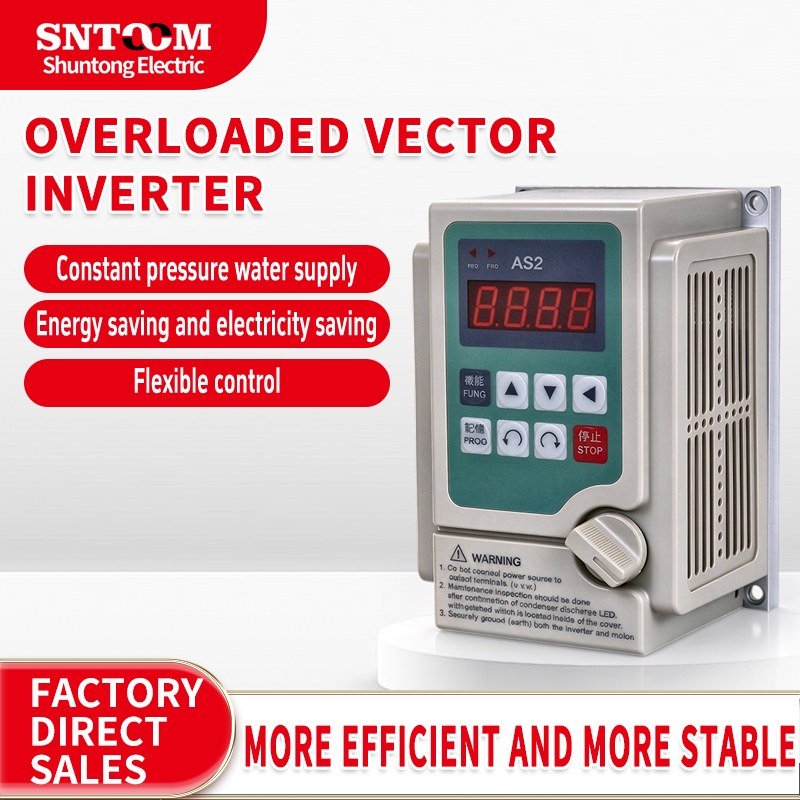
What an AS2 Drive Can and Cannot Run: A Load-by-Load List
What an AS2 Drive Can and Cannot Run: A Load-by-Load List
The most common message in our inbox is a photo of a motor nameplate and one line: “Will your drive run this?”
The nameplate tells us power, voltage, phases, frequency and full-load current. It tells us nothing about what the motor is attached to. And what it is attached to decides whether a V/F drive is the right answer far more than the nameplate does.
So instead of a power table, here is the list our engineers actually work through. Take your load, find it below, and read the condition next to it.
How to read this list
Three outcomes are possible for any load:
- Yes — the AS2 runs it with standard settings.
- Yes, with a condition — it runs it, but something has to be added or set: a longer ramp, a reactor, a lower carrier frequency, a derated model.
- No — the duty needs vector control or an encoder, and no parameter setting will substitute.
The AS2 covers 0.4–7.5 kW on 220 V single phase or 380 V three phase, with 150% starting torque and 150% overload for 60 seconds on the G-type rating. Everything below assumes that envelope.
Constant-torque loads
Belt conveyor, horizontal
Yes. This is the textbook AS2 duty. Set the acceleration ramp long enough that the belt comes up to speed without a jerk — three to five seconds on a loaded belt is usually enough — and the 150% starting torque handles breakaway. Set the deceleration ramp the same way; if the load is heavy and stops fast, the motor regenerates and the drive trips on overvoltage. That trip is not a fault, it is the ramp being too short.
Screw conveyor or auger started full
Yes, with a condition. An auger that starts with material in the trough needs considerably more breakaway torque than a belt. Enable over-current stall control and extend the ramp. If the drive still trips at start with the current limit at its ceiling, the model is undersized for the duty — go one size up rather than trying to tune around it.
Chain or slat conveyor with frequent starts
Yes, with a condition. Frequent starts mean the drive spends a lot of time in the acceleration current range. Derate the model if the starts are more than a few per minute, and check that the enclosure has airflow — natural convection cooling needs clearance above and below the heatsink.
Mixer, paddle or ribbon, light material
Yes. Ramp up over several seconds and the load follows. If the mixer starts with settled solids, treat it as a heavy-start duty and size up.
Mixer with high-viscosity product
Marginal. The starting torque can approach the running torque, and viscosity rises as the batch cools. Check the 150% starting torque against the mixer manufacturer’s starting requirement. If they quote a figure above 150%, this is not the drive.
Variable-torque loads
Centrifugal pump
Yes. Square V/F curve, PID on pressure or flow, done. This is where a V/F drive outperforms its price by the widest margin, because the affinity laws mean a 20% speed reduction cuts power by roughly half. The drive pays for itself on the electricity bill, not on the control capability.
Submersible pump on a long cable
Yes, with a condition. Long motor cables between drive and pump distort the output waveform. Below roughly 50 metres it is rarely a problem; beyond that, add an output reactor and check the motor insulation class. Do not solve a long-cable problem by raising the carrier frequency — that makes it worse.
Fan, axial or centrifugal
Yes. Square V/F curve for the variable-torque characteristic. The 400 Hz upper limit covers high-speed blower duties where a standard 50 Hz motor is deliberately over-driven.
High-inertia fan
Yes, with a condition. A large fan wheel takes a long time to accelerate and a long time to stop. Extend both ramps considerably, and enable DC braking if the fan must stop quickly — otherwise it coasts for minutes and the process waits.
Loads that need a condition, not a different drive
Reciprocating compressor
Yes, with a condition. High starting torque, and the load pulses with each stroke. Use a long ramp, keep the carrier frequency low enough that the drive is not switching hard, and accept that the current display will swing. If the compressor has an unloading valve, use it — starting unloaded is far easier on the drive than starting against pressure.
Positive-displacement pump
Marginal. Breakaway torque is high and the load does not fall away with speed the way a centrifugal pump’s does. Check the starting torque figure. If the pump manufacturer specifies a bypass or an unloading start, use it rather than sizing the drive up.
Centrifuge
Depends on the type. A low-inertia basket centrifuge ramps up fine. A high-inertia decanter needs a long acceleration and an even longer deceleration, and the energy has to go somewhere — if braking is frequent, the drive needs a braking unit and resistor. That is an accessory, not a different control mode.
Woodworking dust extractor or baghouse fan
Yes, with a condition. These run continuously at fixed speed, which suits V/F perfectly. The condition is environmental: the drive must be in an enclosure, because IP20 inside a dust-laden air stream will fail. Cooling is by natural convection, so the enclosure needs its own ventilation path that does not pull dust through the heatsink.
Loads this drive cannot do
Hoist, crane, lift, or anything that must hold a load stationary
No. Holding torque at zero speed requires vector control or an encoder. A V/F drive at zero frequency produces no useful torque and the load falls. There is no parameter that changes this.
Winder, unwinder, or tension control
No. The requirement is torque control, not speed control. V/F controls the voltage-to-frequency ratio; it does not control torque.
Machine tool spindle with rigid tapping or orientation
No. Position and torque response are both required.
Anything that must not slip under a load step
No. A V/F drive responds to a load step by slowing down and recovering over the ramp. If the process cannot tolerate that dip, the drive is the wrong category.
Three loads that are not on the list but come up every week
Cooling tower fan
Yes. Outdoor installation, fixed speed most of the year, square-law load. Two conditions: the drive goes in a weatherproof enclosure, and the enclosure ventilation must not pull the tower’s own moisture through the heatsink. Mount the panel away from the drift eliminator outlet.
Dust extraction or shot-blast fan
Yes, with a condition. Continuous fixed-speed duty is ideal for V/F. The environment is the problem, not the load. IP20 in a dust stream fails within months; the drive belongs in a sealed enclosure with a filtered air path, and the filter becomes a scheduled maintenance item.
Rewound or unknown motor
Yes, and this is a V/F advantage. A rewound motor has different resistance from the original, and a motor of unknown history may have none of its original parameters. A V/F drive does not need them – set rated voltage and frequency and it runs. This is the single most common reason buyers choose V/F over vector on old plant.
When the load changes partway through the shift
A machine that runs one product in the morning and a heavier one after lunch is not a sizing problem, it is a parameter problem. Two ways to handle it on a V/F drive.
Use the multi-speed function. The built-in PLC holds up to eight preset speeds, selectable from DI terminals, so a changeover switch on the panel selects the recipe and the ramp and speed follow.
Or accept the current limit and let over-current stall control manage it. The drive will accelerate more slowly on the heavier product instead of tripping. That is usually acceptable on a conveyor and usually is not acceptable on a machine with a fixed cycle time.
Two conditions that apply to every load above
Sizing to the motor, not to the job. A drive rated well above the motor runs the motor at low flux, and at low frequencies that can be unstable. Size the drive to the motor’s full-load current, then check the overload specification against the duty. If the duty is heavy, take a larger frame — not a larger jump.
The cable run. Motor cable length, screening and separation from control wiring matter more on V/F drives than buyers expect, mainly because the symptoms look like drive faults. If a drive that ran fine on the bench trips on site, the cable is the first thing to check, not the parameters.
Sending us the question
If you want a yes or no rather than a table, send four things: the motor nameplate photo, what the motor drives, how often it starts per hour, and the cable length between drive and motor. With those we can answer in one reply, and if the answer is “this drive will not do it” we will say so rather than sell you one.
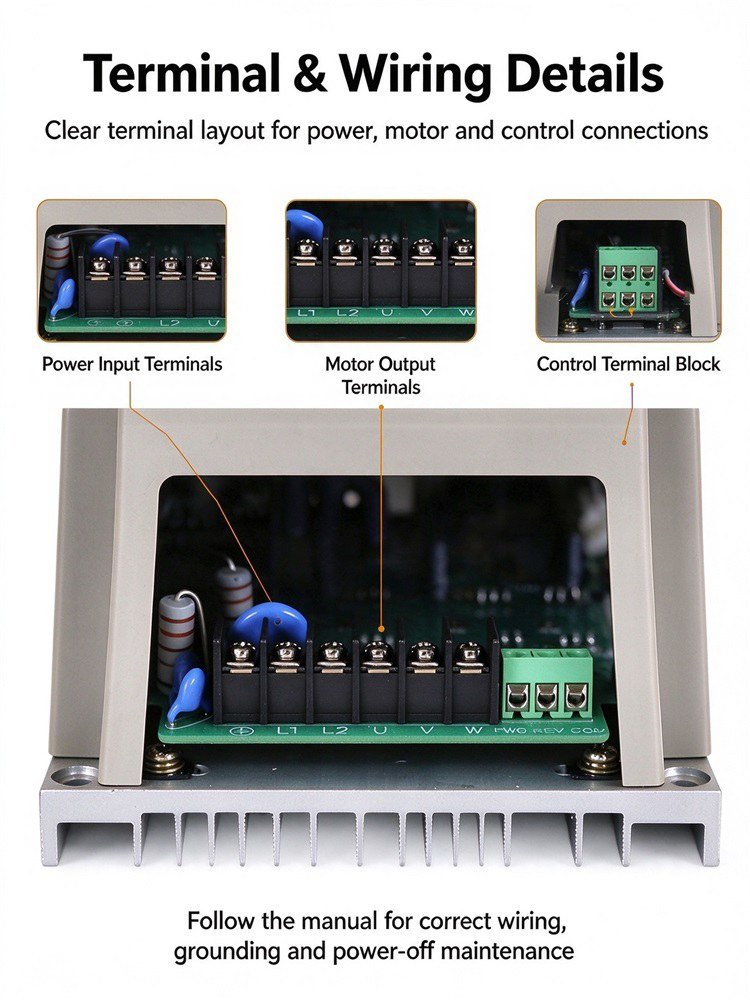
The AS2 series page has the model list, terminal layout and full technical specification. Datasheet, wiring diagram and sample orders on request.